Interpreters’ Room
“It is in language that expectation and fulfillment make contact.” ¹
– Ludwig Wittgenstein
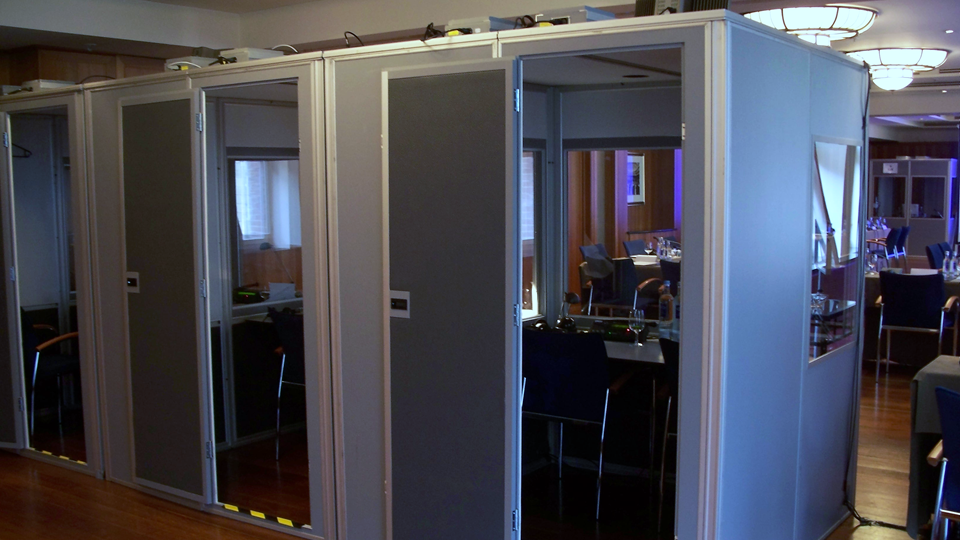
Photo: SILKROSS events
Key Points for Interpretation Equipment
- The interpreters’ workplaces,
- Transmission of interpreted languages,
- The requirement—which degree of internationality to be ensured in which rooms or areas for which time.
What Is an Interpreting System?
An interpreting system is an audiotechnical system that allows conference interpreters to listen to a spoken contribution and to reproduce it orally at the same time in a desired target language.
Microphones are indispensable in environments where interpreters maintain communication for multilingual groups. This may involve either whispering through a portable interpreting system ² or interpreting simultaneously in an interpreting booth. Interpreting systems can also be integrated into multilingual tele‑conferences, so that all invited working groups and interpreter teams can cooperate with good image and sound quality, regardless of where they are.
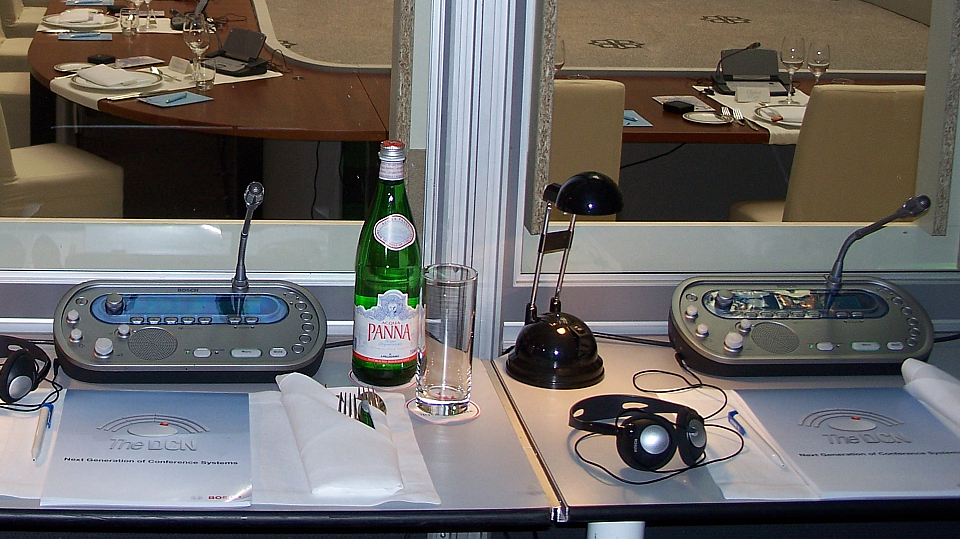
through a three-person interpreter booth
with two visible interpreters’ workplaces.
Photo: SILKROSS events
Interpreters’ Workplaces
Conference interpreters need a protected space in which they can work without being disturbed. That space is offered by the interpreting booth.
The size and composition of the interpreter team depends on the language combinations of the team members as well as on the conference topic and event duration. It is only after the interpreter team has been put together that it is finally clear how many booths with how many working places are required. In general it is two working places per language combination.
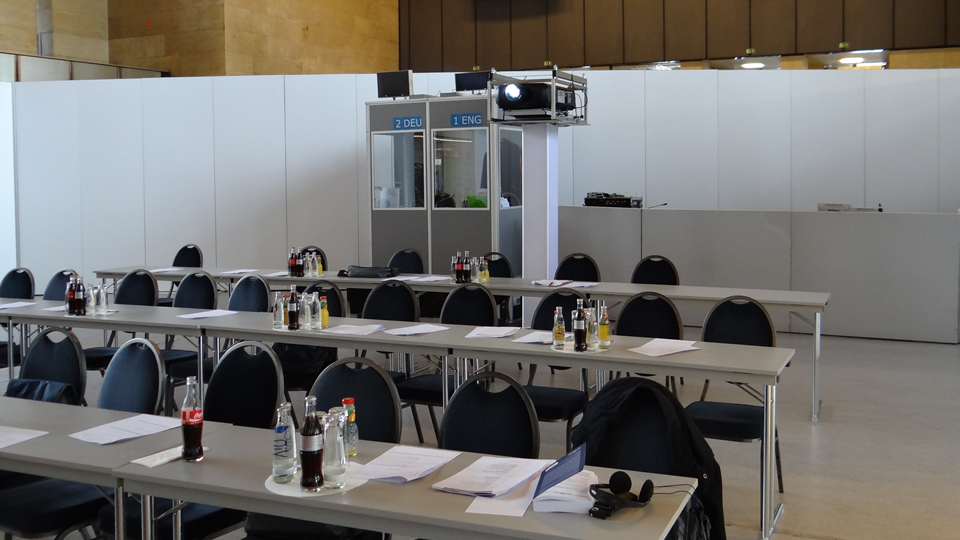
The interpreters are provided with a good overview of the event here.
Photo: SILKROSS events
Transmission of Simultaneous Interpretation
Participants can usually receive their desired language interpretation through one of the following transmission methods. The original voices and sounds remain discreetly in the background, thus preserving their effect on sensory perception.
Mobile to their seats
Invisible infrared light is used that carries the signal with audio information through the conference room. The speakers and guests can select their desired target language on their personal receivers. This method provides a high level of security against unauthorized interception. Another version that is often used for guided tours uses wireless radio transmission.
Through a discussion system
A discussion system can be directly connected to the interpreting system to create a closed conference system.
Voice‑over during theatre plays or film shows
The interpretation comes through a loudspeaker system or directly through headphones. Theatrical interpreters are not only concerned with the specifics of the production and the vernacular translation of a piece, they are also sensitive to the perceptions, previous experiences, and listening habits of the audience.
Audio and video conferencing
If a multilingual video or tele‑conference is held simultaneous interpreters in every conference location can be integrated directly in the procedure of the conference. A secure network is then set up to connect the conference venues with the locations of the other microphone, conference, or interpretation systems. This method is also suitable in the event of limited availability of space in the conference room.
The simultaneous interpretation services available in the conference rooms can be tailored to the needs of the participating groups. For this purpose, you can draw on the language pool of the subject-matter expert interpretation teams.
Directly
During personal meetings the interpreters can work directly to support interaction between the interlocutors. They do not use equipment and talk directly to the participants.
Transcribed interpreting (STTI) ³
In transcribed interpreting, the interpreter immediately relays the interpreted language and the current content of the conversation as written text. This text is displayed on special screens or incorporated into the presentation as subtitles. Depending on the agreed‑upon requirements, the text can be detailed, contain highlighted explanations, or be written in summary paragraphs for similar content.
Subtitles improve the understanding of audio and video content for people who have difficulty following the spoken language, e.g. non‑native speakers and people who are hard of hearing.
Documented
If there is a need for multi‑channel video recording the language channels that come with the original video are selected in a context menu. However, often a multilingual audio recording is sufficient. Both are added‑value services by the interpreter team for which an extra copyright fee can be charged.
Notes
¹ Ludwig Wittgenstein, original sentence: “In der Sprache berühren sich Erwartung und Erfüllung.”
The sentence was first elaborated in the manuscript Philosophical Grammar (Original title: Philosophische Grammatik) [PhG No.92], later addressed in the book Philosophical Investigations (Original title: Philosophische Untersuchungen) [PI §445] in 1948, and published posthumously in 1953.
² also referred: tour guide system.
³ STTI stands for speech‑to‑text interpreting, which is performed by interpreters. In contrast, STT (speech‑to‑text) is generated by artificial intelligence process chains.